by Joe Cole
(Click here to read the case study report described below)
 In October, I completed the ten-month Design for Sustainability course through the Global Ecovillage Network and Gaia Education. The Gaia Education Design for Sustainability (GEDS) course is a 10-month certification program that presents a “comprehensive overview of the necessary components for sustainable community design,” and is “based in the experiences of hundreds of ecovillages acting as living laboratories over many decades.”
The final phase of the course involves a Design Studio where teams of students explore a real case study around the four Dimensions of Sustainability–Ecological, Economic, Social, and Worldview. My four-member Design Team–Leah Gibbons, Hamish Thomson, Thumbs Dijgraff, and me—worked on Hart’s Mill for our Case Study. It was a joy working with and learning from these experienced, insightful, and wonderful people, and together we generated an 80-page report on Hart’s Mill’s status as a sustainable ecovillage, with recommendations on how the community could expand and deepen its commitments to sustainability.
In our work, we observed that Hart’s Mill is at a critical time in its development, and still has key decisions to make concerning the nature of the community. Our Design Team took seriously Hart’s Mill’s stated goal of creating an Ecovillage (versus a more conventional development). We utilized the GEDS model of four dimensions of sustainability, giving attention to Ecological, Economic, Social and Worldview dimensions and the ways they synergistically interact for systemic sustainability.
 Based on our training in the GEDS course, we concluded that Regenerative Design values and strategies offer the best current guidance for creating an Ecovillage. Our main recommendations are for Hart’s Mill to adopt a Regenerative Sustainability framework to guide its vision, mission, aims, and practical projects. Our intention was not to supplant Hart’s Mill’s current plans, but rather to help manifest the latent potential of Hart’s Mill as an intentional community and as an ecovillage.
So what is Regenerative Sustainability? Regenerative Sustainability aims to re-weave human and natural communities into a co-evolutionary whole, where humans exist in symbiotic relationship with the living lands they inhabit. Regenerative communities strive to create the conditions and capacities for a thriving and abundant future for all life. This means continually evolving as a project, working across scales (microscopic to macroscopic, local to international), and developing care and commitment for the land, ecosystems, social systems, and larger wholes of which we are a part.
One specific example for how this could apply to Hart’s Mill would be to reorient our project to caring for our local and regional watershed. Hart’s Mill is near the headwaters of McGowan Creek, leading to the Eno River, Falls Lake, the Neuse River, Pamlico Sound, and the Atlantic Ocean. This location gives Hart’s Mill an important role to play in creating a healthy and thriving watershed through regenerative development. If Hart’s Mill recognizes that it is part of larger living systems and that it has a unique role to play in helping those systems manifest their highest potential, health, and vitality, th en the community can become a catalyst for regeneration of the larger living systems of which it is a part.
Many of Hart’s Mill’s Principles and Intentions already reflect a Regenerative Sustainability paradigm. These include: “an abiding commitment to each others’ and the lands’ well-being” (PI-1); “embracing the larger web of life” (PI-2); “integrate harmoniously with the land and each other” (PI-11); “deepening connections with one another and with the land” (PI-15); facilitating “sustainable relationships, growth, and trust” with neighbors (PI-30); “enabling the creation and sustenance of other eco-villages” (PI-33); and “continual reassessment” (PI-36). When applied more consciously, the Regenerative Sustainability paradigm and Regenerative Development can guide Hart’s Mill in achieving its goals and playing a valuable role in helping its larger community of life transform to regenerative sustainability.
To this end, our Design Team recommended the following revision of the Hart’s Mill Vision:
 “Hart’s Mill ecovillage lives our interconnectedness with all of life, living as nature. Through this interconnectedness, and through fulfilling our unique value-adding role in our larger whole, we reweave all of life and create systemic perpetuating vitality and health in place and in the living systems of which we are a part.”
Our Design Team also recommended the following revision of the Hart’s Mill Mission:
“Hart’s Mill is a regional center for regenerative agriculture and living, adding value to and catalyzing transformation to regenerative sustainability of our larger community and bioregion while providing our inhabitants with a cooperative, celebratory, and co-creative social and work life. Hart’s Mill uses regenerative agriculture, building, economic, and living technologies to continually increase the health and vitality of the entire living system.”
By enhancing the community’s Mission and Vision, Hart’s Mill can become the US East Coast Center for Regenerative Living. Hart’s Mill would be a transformational project not just locally, but in its bioregion and throughout the US, elevating the conversation from sustainability to regeneration so that Earth can thrive again and be a place where life flourishes.
In addition to our Design Team’s main recommendations around adopting a Regenerative Sustainability framework, the report is also full of specific ideas and suggestions for each of the four dimensions of sustainability.
 For the Worldview Dimension, our team recommends that the community develop a holistic worldview that lives the reality of interdependence and interbeing. This spiritual framework is a foundation for the commitment to Regenerative Sustainability. Creating a community such as Hart’s Mill is inherently spiritual, and nurturing this aspect of community life will greatly enrich Hart’s Mill members and its endeavors.
For the Social Dimension, we observed that many members would benefit from deepening collaborative skills and avenues of participation in community governance. Hart’s Mill members express a great deal of appreciation for the community’s leaders, while also revealing a spectrum of views on the effectiveness of leadership at Hart’s Mill. The community has needs for feedback systems, younger leaders, more effective decision-making, and improved communication, as well as the need to address power and conflict more proactively. Our Team also recommends that Hart’s Mill create an Educational Center for Regenerative Sustainability, Cooperative Governance, and Social and Environmental Justice as a top, near-term priority.
For the Economic Dimension, we recommend that Hart’s Mill develop an internship program for youth to work and learn on the land, beginning with scheduling five workshops in 2018, including workshops to build an outdoor kitchen and classroom using natural building techniques. Hiring a volunteer manager and marketing specialist would be crucial for the success of such programs. We also recommend innovative strategies for attracting farmers and rewarding them for co-creating farm and community infrastructure. Hart’s Mill can then purchase any upgrades and investments from the farmer when and if they leave. Finally, while financing the development of Hart’s Mill is an ongoing area of concern, by deepening the community’s commitment to Regenerative Sustainability, Hart’s Mill will stand out and attract members, allies, donors, financers who are inspired by its sustainable mission.
 For the Ecological Dimension, Hart’s Mill can become a leader in regenerative agriculture, green building, and renewable energy. The community can grow food in a way that increases the health and functioning of the surrounding ecosystems. Regenerative design can guide water use, reuse, and wastewater treatment through rainwater catchment, living gray water systems, composting toilets, and constructed wetlands. Hart’s Mill can become an inspiring model in renewable energy through building for Net Plus renewable energy generation, maximizing energy efficiency, and collaborating with local and regional groups working for a renewable energy economy.
That is a sampling of highlights from the Case Study.
On December 3rd, about ten community members gathered to hear a presentation on the Case Study and discuss the recommendations. There was broad agreement that more conversation is needed, so hopefully we will continue to explore how our community might benefit from the results of the Design Team’s work in the coming months and years.
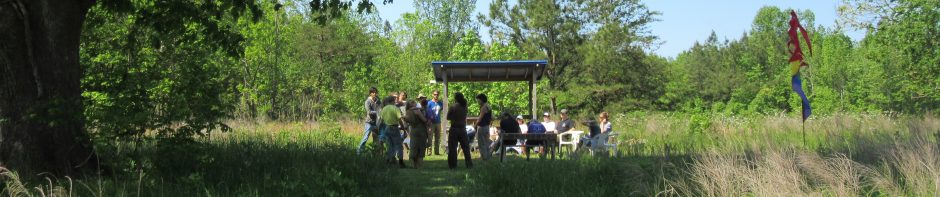
 Several of us (Paul, Hope, Tain, Jeffry, and I) were privileged to explore our land on February 16th with Ken Moore and his wife, Kathy Buck. Ken is the former long-time assistant director of the North Carolina Botanical Garden and clearly knows and loves the woods. We proceeded from Hart’s Nest in balmy weather and made our way to the relatively unexplored “South 40” where the latest trail-building is being done. It soon became apparent that the down-side of walking with an expert is that so much excites them; it can be difficult to make much forward progress!
 and should not be cut down unless it is “in the way”, such as in the garden. Wildlife is not affected by P.I.’s toxins. Its flowers are frequented by bees, numerous birds eat the berries, and deer and rabbits browse the twigs.
 and should not be cut down unless it is “in the way”, such as in the garden. Wildlife is not affected by P.I.’s toxins. Its flowers are frequented by bees, numerous birds eat the berries, and deer and rabbits browse the twigs.
 Ken’s enthusiasm is contagious and his knowledge prodigious; his contributions to our species inventory are invaluable. Many new tree identification tags have been placed, as well as temporary labeled popsicle sticks and surveyor’s tape. If you come across any of these, take a moment to note what’s alive and well on our land.
 The past few years of political, cultural and social upheaval have challenged me to examine my own thoughts, emotions, language and behaviors around issues of racism, classism, ageism, sexism, and many of the other ‘isms’. I read, I listened and I engaged mostly with my friends, both in and outside of the HM Community, on these topics . Gratefully, I found many others were also ready to participate in this dialogue.

 In October, I completed the ten-month Design for Sustainability course through the Global Ecovillage Network and Gaia Education. The Gaia Education Design for Sustainability (GEDS) course is a 10-month certification program that presents a “comprehensive overview of the necessary components for sustainable community design,” and is “based in the experiences of hundreds of ecovillages acting as living laboratories over many decades.”
 Based on our training in the GEDS course, we concluded that Regenerative Design values and strategies offer the best current guidance for creating an Ecovillage. Our main recommendations are for Hart’s Mill to adopt a Regenerative Sustainability framework to guide its vision, mission, aims, and practical projects. Our intention was not to supplant Hart’s Mill’s current plans, but rather to help manifest the latent potential of Hart’s Mill as an intentional community and as an ecovillage.
 en the community can become a catalyst for regeneration of the larger living systems of which it is a part.
 “Hart’s Mill ecovillage lives our interconnectedness with all of life, living as nature. Through this interconnectedness, and through fulfilling our unique value-adding role in our larger whole, we reweave all of life and create systemic perpetuating vitality and health in place and in the living systems of which we are a part.”
 For the Worldview Dimension, our team recommends that the community develop a holistic worldview that lives the reality of interdependence and interbeing. This spiritual framework is a foundation for the commitment to Regenerative Sustainability. Creating a community such as Hart’s Mill is inherently spiritual, and nurturing this aspect of community life will greatly enrich Hart’s Mill members and its endeavors.
 collaborative skills and avenues of participation in community governance. Hart’s Mill members express a great deal of appreciation for the community’s leaders, while also revealing a spectrum of views on the effectiveness of leadership at Hart’s Mill. The community has needs for feedback systems, younger leaders, more effective decision-making, and improved communication, as well as the need to address power and conflict more proactively. Our Team also recommends that Hart’s Mill create an Educational Center for Regenerative Sustainability, Cooperative Governance, and Social and Environmental Justice as a top, near-term priority.
 program for youth to work and learn on the land, beginning with scheduling five workshops in 2018, including workshops to build an outdoor kitchen and classroom using natural building techniques. Hiring a volunteer manager and marketing specialist would be crucial for the success of such programs. We also recommend innovative strategies for attracting farmers and rewarding them for co-creating farm and community infrastructure. Hart’s Mill can then purchase any upgrades and investments from the farmer when and if they leave. Finally, while financing the development of Hart’s Mill is an ongoing area of concern, by deepening the community’s commitment to Regenerative Sustainability, Hart’s Mill will stand out and attract members, allies, donors, financers who are inspired by its sustainable mission.
  For the Ecological Dimension, Hart’s Mill can become a leader in regenerative agriculture, green building, and renewable energy. The community can grow food in a way that increases the health and functioning of the surrounding ecosystems. Regenerative design can guide water use, reuse, and wastewater treatment through rainwater catchment, living gray water systems, composting toilets, and constructed wetlands. Hart’s Mill can become an inspiring model in renewable energy through building for Net Plus renewable energy generation, maximizing energy efficiency, and collaborating with local and regional groups working for a renewable energy economy.
 A small group of six stalwart Hart’s Millers and two guests showed up on a cold dreary afternoon for our December 2nd workday. Many thanks to Doug Jones, of neighboring community Earth’s Turn, for coming out and working with us! We aim to return this generous gesture.
  clearing the overgrown field east of the pavilion. Small saplings had to be removed by hand in order to safely bush-hog there.
  wreaths. Honorary canine member, Eya, alternated chilling nearby with dragging her leash through the underbrush to check on us.
 Mid-afternoon there was a tour of the land, led by Hope. Exploratory member Link, with Hannah, and their small daughter Fern, got to see what we Hart’s Millers have been up to. Walking on the new pond trail, we hopscotched through the creeping cedar on wooden stepping “stones” cut and placed by Jeffry and Margret.
 On the way back to the Nest, we we were startled by a colorful, snake-like shape off to the side. This is Margret’s newest painterly gift to the land. Wait until it peers out of the undergrowth come spring.

 Emerson Waldorf School’s Children’s Faire and Artisan Marketplace. Christina, Marilyn, Rita, Virginia, Charles, Anthony, and Paul greeted visitors and engaged in conversation about our community. Christhome. All agreed that it was a beautiful event. Thanks to Bailey and Gaius for opening this door for Hart’s Mill.


 Thanks to everyone who helped make this time all about community, gratitude, generosity, and creativity!


 This bright, cool afternoon was perfect for planting our first crop of garlic on the land. Jeffry and Tain, encouraged by Eya, planted about 900 garlic cloves (one 100-foot bed, with 3 rows, approximately 3 cloves per foot).
 It’s a rare moment for Paul and me: sitting on the back deck in the afternoon calm, gazing at the tall oaks and fluffy pines just beyond the backyard fence. Serenaded by the quiver of fading autumn leaves brushed by the breeze, the ever-present insect drone, bird calls and chirps. All is quiet and calm; a welcome respite after two months of nearly constant motion as we all settle into this house with a big footprint and mission to match.


 n September, we greeted a steady stream of visitors for the Hart’s Nest Open House (or “Hart-warming”). Guests enjoyed tours of the land, good food and drink, and a spirited performance by Jewelsong, a women’s vocal quartet which includes Marilyn as a member. They filled the Nest with sweet harmony.


 A major meeting on Sunday, 24 September marked the successful culmination of an intensive research and planning phase as we organize ourselves to head again into architectural design work with professional Design Partners.
 official community meeting there. Question rounds included all members who attended, many of whom were active on the Working Groups and had followed proposal development carefully online. General Circle made the ultimate decisions. Discussion was grounded and immensely aided both by the coordination and parallel structuring of proposals – credit PDD and the Working Group conveners: Christina, Charles, Hope, Katy, and Anthony – and by skillful facilitation both by our impressive inside talent (yay, Maria!) and an outside facilitator, Mark Molitor, who joined us for the day as well as offering h
 is sage counsel in numerous lead-up planning sessions (with Maria, Hope, Jeffry, and Anthony). Most of all the success of the work was a credit to the focused intent of all who attended – many thanks to all!!!
 x” design. Inside layouts remain to be decided, but one natural floor plan places living & dining rooms under the lower end of the big roof, with its sloping ceiling creating “lift” above. Under the upper end of the big roof could be a half second floor with bedrooms and a bath, over a downstairs kitchen and another BR or study. (This is the basic 3 BR version.) Stairs rise from the living/dining “great room” to the second floor, allowing for a balcony overlooking the lower area. A detailed and illustrated Sunslope proposal can be found
  least impact on the environment, the longest life, lowest maintenance, greatest damage resistance, lowest cost to maintain, maximum attention to the human factor, and reducing toxicity as much as possible. A detailed proposal breaks down sustainability goals by major categories: Energy (ways to get at least to net zero and hopefully better); Water (self-sufficiency in the long run); Materials (major durability and longevity with least impact, and highlighting some highly attractive potential new options); Appliances and HVAC; Lighting; Food (permaculture zones 0 / 1 would be our porches!); Waste; and other Design Features. We reaffirmed our intention to design and make full use of Common House facilities and community wide solutions to reduce individual house space and appliance requirements, and to promote life style changes to assist in that goal as well. A full and consented-to Sustainability proposal can be found
  diversity, and social and ecological justice for ourselves and the land. Housing affordability—short and long term—is a paramount (though not sole) concern if we are to be able to attract and retain members across spectrums of age, race/ethnicity, gender, agrarian skills, etc. The Equity Working Group therefore brought a specific proposal to GC whose key features include pegging our house cost goals to affordability for people earning 85-100% of Area Median household Income (about $46,000-$54,000 for two people in Orange County in 2015), along with flexible housing options, such as shared housing and farm housing, and energetically pursuing sources of subsidies and alternative financing. The GC discussion was highly supportive, and fertile, leading to development of the proposal, with final consent pending adjustment and further development. A detailed background report can be found