by Leah Gibbons
Workshop 1 Activity and Outcomes*
We had an exciting time at Hart’s Nest on November 17-18 exploring and applying a development and design process called regenerative development. The aim was to discover how regenerative development might add to and enhance the work of Hart’s Mill. Many thanks to Hope, Joe, Katy, Maria, Marilyn, Paul, and Randy for participating.
We began the process by discussing what participants love about Hart’s Mill. Participants love the human relationships, social and economic ideal, organizational structure, generosity, desire to transform themselves and the world, creativity, persistence, the well-defined common values and principles, opportunity for innovation, and willingness to take leadership roles and responsibility. They also love the beauty of the land, its water, its diversity of life, its gifts (like edible mushrooms), and the opportunity to become intimate with place.
I then introduced the concept of regenerative development. I explained that  regenerative development is a system of methodologies that develops capacities in living systems to continually evolve to higher levels of health and well-being, from the scale of individuals to sites, neighborhoods, cities, and beyond. Regenerative development is different from other approaches in several ways. It shifts us from:
- Focusing on problems to manifesting potential
- Working with parts to working with wholes
- Static ‘solutions’ to growing capacities
- Scarcity to abundance
- Addressing symptoms to addressing causes—worldviews and consciousness
- A parasitic to a mutualistic relationship with nature
- Project-focused to value-adding (i.e., being of service) to the larger context
 Regenerative development charts a path for thrivability within which more specific regenerative and ecological design technologies and strategies may be used. These include biophilia, biomimicry, bioclimatic design, Permaculture, regenerative agriculture, and Living Building and Community Challenges.
I introduced the regenerative community development tools I have developed and am piloting as part of my dissertation research. These are intended to help guide communities through the regenerative development process. These may used throughout time to adjust and adapt concepts, goals, and strategies as contexts and conditions change.
Using the tools to guide us, we dove into exploring what gives life to this place. We looked at the larger communities of which Hart’s Mill is a part as well as at Hart’s Mill itself. At the next largest scale up, Hart’s Mill and adjacent neighbors form a community. At the next largest scale, this context seemed appropriate:
And then this:
We also found thinking about Hart’s Mill as part of the Upper Neuse River Basin helpful. Looking at how all of these scales relate to one another, we explored ecological and social flows, patterns, and relationships that have given, currently give, and could give your community and its surrounding landscape vitality. We looked at elements for life including water, organisms (including people), nutrients, soil, infrastructure, and information, among others. We discovered that west-east flows of humans, commerce, water, and creatures (beavers, coyotes, foxes, turtles, birds) have been and continue to be important. We found that connections, exchanges, and mutually-beneficial relationships amongst these elements are important for vitality.
We discovered the essence of Hart’s Mill—what defines it as a unique whole and gives it life and vitality—and articulated it in a short Story of Place and regenerative development concept:

Hart’s Mill is a connecting place, rooted in rich biological and cultural diversity and flows that bring forth vitality and life. At a time of great social and environmental dysfunction, we are called forth as a catalyst for collaborative transformation. We are an agrarian community of learning, inhabiting, practicing and service committed to healing our relationships to each other and the earth, within Hart’s Mill and as an integral part of our larger community.
This statement can guide regenerative development efforts, connecting past, present, and future from the scale of individuals to the region.
 We began exploring potential collaborations and guild relationships. These are relationships within the larger community that would result in mutual benefits for all. Potential members include neighbors, other local communities, Minka Farms, Triangle Land Conservancy, Eno River Association, Orange County Planning Department, City of Mebane, Commission for the Environment, local universities and schools, green developers, Sally Greene (Orange County Commissioner). Participants noted some actions that can be taken right now to generate income and move towards Hart’s Mill’s vision, including on-line teaching and beginning an educational center at Hart’s Nest.
Next, we briefly explored how regenerative development enhances Hart’s Mill’s current approach and thinking. Thoughts included:
- The inclusion of larger contexts and systems; understanding your role within those systems
- Frameworks to guide thinking, discussion, and action in Hart’s Mill and beyond for community members and the professionals who work with you
- A language to communicate who Hart’s Mill is at its heart
- Help looking at the bigger picture
 For our next weekend workshop, we intend to evaluate Hart’s Mill’s current principles, vision, and mission using its regenerative development concept and the regenerative community development evaluation tool. We will then use the tool to co-create regenerative development goals and strategies specific to Hart’s Mill. We will then use the tool to discuss how specific design technologies and strategies can help implement regenerative development. We will discuss potential regenerative development indicators for your community. We will also explore your role as regenerative individuals in enabling vitality in Hart’s Mill and beyond.
*If you are a Hart’s Mill member interested in attending Workshop 2 on December 22-23, please contact Hope at hopematrix@fastmail.com
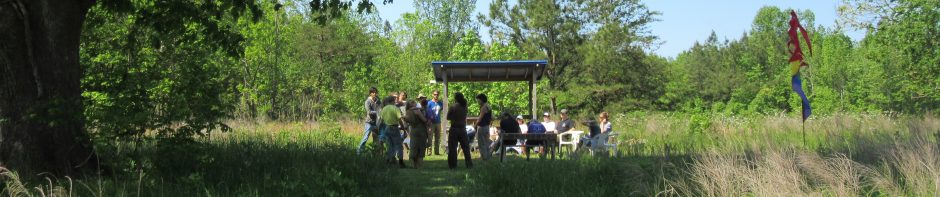
 It was a cloudy, blustery day—a perfect time to step into the shelter of the woods to marvel at what the natural world is offering this Spring. Margret, Jenny, and I loosely led eighteen (!) people into an intimate experience through a cozy area nestled between our southern border and the brook connecting the pond with McGowan Creek.
  allowing us to avoid the rain-swamped areas of our better-known trail network. Very few Hart’s Millers have been this way, and it was a delight to introduce everyone to the charms of this tucked-away spot.
 its presence seems to bestow a sense of timeless enchantment.
  border, it was striking how different the Hart’s Mill forest appeared from our neighbor’s to the south. We don’t know the full history of this land, but it’s possible that this forest was clear cut, and even farmed, in the not too distant past. It was certainly planted with pines at some point. In contrast, the fairly open mixed-hardwood forest next door gave us an idea of what this land may have looked like many years ago—and may appear again some decades hence.
 brook at the bottom connects the pond with McGowan Creek and it was bustling, tunefully shifting the overflow towards the wetlands. The children in the midst had a high time splashing in the water. It’s a good thing they wore their rubber boots!
 noses, and feet. We indulged our senses, gazing at tiny new Tulip Tree leaves, feeling the quiet presence of the trees, scenting the wind, and listening for…well…anything that captured our attention. People enjoyed this solo time guided by their own druthers.
  under a light rainfall to enjoy a cup of hot tea, snacks, and reflect on what we noticed.
 A group of 20 LUCKY FOLKS showed up for the March Last Saturday event with the dynamic activist and organizer,
  Let’s face it: Hart’s Mill is at a stage where we need to attract more members who are aligned with our vision and mission. It’s not unusual for a few key people to do much of the work in organizations in the beginning, but at a certain point the system needs more energy. Evangeline outlined how starting with as few as five core leaders we can attract fifty, even five hundred more. Sounds impossible? Let’s see how this works!
 It all starts with…WHY do we want to build bigger teams? What’s our purpose? What inspires us and keeps us going at the end of a long day? And in particular, why do we want to bring in more people RIGHT NOW? We called out some of the reasons why we will persevere, no matter what, until we actualize our vision.
  So, we’re having an event. RADICAL WELCOME comes next. How prepared are we to craft a really great experience? Are people greeted with a smile? Is there a warm and lively atmosphere? Do people know where to go and what to do, right away? Are there snacks and other comforts? What can we do to help people to be glad they came, from the get-go? Do our guests feel appreciated? Be sure to treat everyone like royalty!
 And how about ROLES? Events are multi-faceted and people want to feel useful and valued. (Just ask Nell and George, who felt really good about their event contributions.) Are we clear about the tasks that need to get done, and how to do them? Do people have the tools/information they need to succeed? (BONUS FUN FACT: Do you know the #1 thing people fight about in organizations? Answer: Lack of clarity in roles and goals.) People like to be engaged; to do something that contributes to success. (Note to Hart’s Mill: find ways to get people involved other than inviting them to observe meetings…at least in the early stages….)
 Okay, we’re in the thick of the event. Notice what happens. The TALENT SCOUTING portion of the process begins with a debrief. Who really rocked at their job, worked hard, took initiative, and followed through? Who has appetite for the community? What skills did people demonstrate? Name the folks we noticed and would really like to have more involved.
  Evangeline suggested that in these conversations we spend half the time getting really curious about our new friend and finding out what calls to them about our community. But then we need a consistent way to describe Hart’s Mill—a SCRIPT, as it were, so that we all have a common way to describe our community. In the last quarter, we ask our friend for something we need, that they can provide. After they say “yes” (of course!), we CONFIRM the request and follow through until it’s done.
 There’s a bit more to it, but these are the basics. This process can be a GAME CHANGER for Hart’s Mill only if we work at it. We need a common way to describe Hart’s Mill (the SCRIPT). We’re so prepared for our meetings–how about being just as prepared for events? Welcome people, assign roles, and follow-up with the stars, one-on-one. Yes, it’s going to take time and effort, and it’ll be worth it to expand our core group and engage the people who are ready and waiting for what we have to offer.


 However you characterize it, Saturday, March 16 was an unqualified success. Despite a last-minute panic on Friday, when it rained heavily–yet again!–Hart’s Mill’s initial foray into community involvement on the farm was full of laughter, thoughtful negotiations, and diligent work. Neither the day nor the newly-prepared planting beds could have been more beautiful. Under the guidance of Jeffry and Margret (a.k.a. Seeing Stars Farm), nine new and seasoned Hart’s Millers set right to work, with the specific goal of raising funds to defray our Angel Donor farm loan.


 seven members met up at the pump house to start heading over to McGowan Creek. We took a detour to Hart’s Ease, where a Honey Locust festoons itself with fearsome thorns along its trunk and branches, with remnants of foot-long seed pods scattered at its feet. From there, we headed north towards Cob Haven, pointing out 3 species of conifers nearby: Loblolly Pine, Virginia Pine, and Red Cedar. At the top of the Far Field, we stopped for a visit with a lone Willow Oak, marveling at its tiny acorn caps and copious branches. Then we headed into the woods.

 There are 22 species of deciduous trees that I’ve seen on the land so far, but many are immature, unsuccessfully competing with the Loblolly pines planted in the late 1990’s after a clear cut of several large stands. Not so along McGowan Creek. Due to the steep slopes and regulations protecting wetlands, this rich strip has gorgeous mixed hardwood trees around 80-100 years old, including magnificent American Beech, Tulip Tree, Red Maple, Oak, and Hickory, while Ironwood and Black Willow proliferate nearer the creek.
 and toads sing their hearts out in a concert that can verge on deafening. Though they were a bit shy with an audience, we heard spring peepers, bullfrogs, tree frogs and many other amphibious utterances as we strolled down the path.


 Thanks to an intrepid band of Hartsmilers working through a cold misty afternoon, the Far Loop Trail in the big southeast leg of our land is now passable all the way around. Margret M and Margaret A, Jeffry, George, Paul, Hope, Nell, and Anthony all helped to clear the last segment on the farthest southeast corner of the land — in what we used to call the Forbidden Territory because it is so far out and for so long seemed so impenetrable. There is more work to be done to make the pathway more commodious and level, but is still fully walkable now. I have yet to measure the length exactly, but my guess is about 2/3 mile. — that’s after about the 1/3+ mile hike from the village area to the trailhead.
 Our crew celebrated this “Golden Spike” moment when we joined both sides of the loop trail. Lots of other people worked on this trail too at earlier workdays: I am sure I won’t remember everyone, but those I do remember include Vanessa and Lizel, Tara and Rick with their son John Michael, Virginia, John, Amy, Lisa, and Tami and Whit from Earth’s Turn. I’ll give myself credit for routing and blazing the trail and plugging away at clearing sometimes alone or with a few others, but it’s been the workday energy of crews like today’s that really made it happen. The hot chocolate at Hart’s Nest at the close of the day was a great treat too. Many thanks to you all!

 model, which was consented to by the General Circle on January 28, 2016. (
 Next on the docket, Katy set about busting the myth of traditional home ownership as a great financial investment. This model is a deeply embedded in our culture; it’s an essential promise of the American Dream. But does it really pan out when you look more closely? Consider the financial meltdown of 2008 when millions of people lost their homes as a result of unscrupulous lending practices. Even setting tumultuous economic downturns aside, a good financial investment is usually defined as one that provides stable and consistent growth that exceeds the rate of inflation where assets retain value, have low maintenance costs, and are easy to buy and sell.
  share in EVERYTHING—112 acres of land, a farm, outbuildings, low energy costs, shared resources, community support, etc.) Paul looked at this from a lot of different angles and results have been strikingly similar: we need something like 60 shares of $40,000 each to raise enough of a down payment to secure financing to build the village. While this is as yet preliminary and uncertain, it’s a place to start.
 As for how to set the basis for a coop share, Making it “per adult” seemed as if it had the most support overall. Several ideas for promoting affordability were put forth, such as adding a surcharge for those who can afford it, offering a share discount or giving partners a break. How about assessing a lower basic share cost for everyone and working out how to raise the rest in some other way? Or, could people buy more than one share to lower carrying costs? Can we set up an internal, low-interest fund to help members purchase a share? As you can see, it was a lively and creative discussion.
  willing to put a cap on the amount of return on their investment rather than allowing the housing market to dictate price? It was Hope’s turn to speak about why she supports a LEHC. First of all, she stated that how we structure ourselves matters because this will dictate how our community behaves over time. Our current economic systems are set up to maximize profit, benefit individual interests, and avoid responsibility if others are harmed. Hart’s Mill, on the other hand, seeks to be financially self-sustaining over the long term by genuinely serving our relationships with each other and the land.
  Hart’s Mill’s values place us securely in the Generative Ownership category, and the LEHC is a generative financial model. Hope concluded by expressing the vision that Hart’s Mill could break this ground in North Carolina and inspire other communities near and far to do the same.
 not in this for the money.” As for rentals, people felt that this should be an option, especially for visitors checking us out, for new members who wish to get to know the community before making a commitment (and vice versa) and for others who want more mobility and flexibility. We could generate income as a guest house. Might it even be possible to set up a rent-to-own arrangement?
 Jeffry and Margret of Seeing Stars Farm (SSF), with support and assistance from the rest of the Land Stewardship Circle, held a Last Saturday event on January 26 at Hart’s Nest. Sixteen people gathered to launch what we are calling the Community Farming Initiative (a.k.a. “Farm-Aid”, minus the famous musicians, sadly).
  brief history of the milestones in HM’s farm development. Jeffry then showed us Bobby Tucker’s Master Farm Plan, indicating the area currently under development for vegetable farming. He explained that Seeing Stars Farm’s existing arrangement with HM is to farm for ourselves for now with the understanding that this will transition to community farming as soon as appropriate.
 especially P&I #3. This will require education, practice, trial-and-error, and so on. Though doing this is challenging without a physical community in place, it seems like a good idea to make a small start on this now. SSF has been farming on our land for two years. We’ve learned a lot and can assist with this new project almost immediately.
  Goals:
 the project this year. Jeffry laid out what SSF would and would not do to support the members, the idea being to help and advise but not actually grow the crops(!). Sales will be through The Chapel Hill Farmers Market, and possibly also internally to HM folks.
 Our last activity involved using “commitment cards” to get specific information about members’ interest in participating. We were so gratified and excited to find that every single attendee signed on for either a growing team or as backup support! We now have in place two teams, interested in such crops as specialty potatoes, Asian greens, cut flowers, beets, and herbs.

 he New Year’s Planning Party on January 13th lived up to its name, with music, dancing, food, fascinating conversation — and a solid path for getting to groundbreaking! 2019 is THE YEAR for Hart’s Mill to pull all the pieces together towards building the integrated Ecovillage of our dreams. Plans for the community farm are well underway, forest stewardship (the Wood Wide Web) has begun, and now we’re blazing to build the village in 2020.
 The timeline lays out an ambitious and optimistic (but not delusional) path focused on getting to groundbreaking. Katy Ansardi and others worked tirelessly with Allie to identify key benchmarks aligned across several project elements that will guide us through the year. It’s a great education in Ecovillage development to see all that must be accomplished compressed on a single page!
  will Hart’s Mill look like/feel like in 5 years? What will we be doing? How will we be living when we are on the land, together? It was a rich experience to go inside and visualize what Hart’s Mill has meant to us, explore the joys and challenges, and envision our lives based on the many Principles and Intentions that have moved us thus far.
 And now….let’s celebrate! Turn up the music, clear the dance floor, enjoy the food and libations, and mostly–have fun with each other! It was a great way to energize all that we have become, all that we are, and all that we will create to make this corner of the world more beautiful, more loving, more sustainable and regenerative. And a lot less crazy.
 That’s what happened Saturday, December 8, when a few hardy souls met at Hart’s Mill (in 40-degree weather) to get started with our
  on Stand 6, respectfully removing some pines from crowded areas and less respectfully whacking every invasive privet and ailanthus sapling we could find. For now, the logs and trimmings are in segregated piles lining the driveway, the former to be chipped for mulch, and the latter to provide habitat and weed suppression while it degrades into useful nutrients for the land.
 Much gratitude to Randy, Jeffry, Hope, Nell, Virginia, and Margret for this rewarding workday.
 at Hart’s Nest on November 17-18 exploring and applying a development and design process called regenerative development. The aim was to discover how regenerative development might add to and enhance the work of Hart’s Mill. Many thanks to Hope, Joe, Katy, Maria, Marilyn, Paul, and Randy for participating.
  regenerative development is a system of methodologies that develops capacities in living systems to continually evolve to higher levels of health and well-being, from the scale of individuals to sites, neighborhoods, cities, and beyond. Regenerative development is different from other approaches in several ways. It shifts us from:
 Regenerative development charts a path for thrivability within which more specific regenerative and ecological design technologies and strategies may be used. These include biophilia, biomimicry, bioclimatic design, Permaculture, regenerative agriculture, and Living Building and Community Challenges.
 We also found thinking about Hart’s Mill as part of the Upper Neuse River Basin helpful. Looking at how all of these scales relate to one another, we explored ecological and social flows, patterns, and relationships that have given, currently give, and could give your community and its surrounding landscape vitality. We looked at elements for life including water, organisms (including people), nutrients, soil, infrastructure, and information, among others. We discovered that west-east flows of humans, commerce, water, and creatures (beavers, coyotes, foxes, turtles, birds) have been and continue to be important. We found that connections, exchanges, and mutually-beneficial relationships amongst these elements are important for vitality.
 We began exploring potential collaborations and guild relationships. These are relationships within the larger community that would result in mutual benefits for all. Potential members include neighbors, other local communities, Minka Farms, Triangle Land Conservancy, Eno River Association, Orange County Planning Department, City of Mebane, Commission for the Environment, local universities and schools, green developers, Sally Greene (Orange County Commissioner). Participants noted some actions that can be taken right now to generate income and move towards Hart’s Mill’s vision, including on-line teaching and beginning an educational center at Hart’s Nest.
 For our next weekend workshop, we intend to evaluate Hart’s Mill’s current principles, vision, and mission using its regenerative development concept and the regenerative community development evaluation tool. We will then use the tool to co-create regenerative development goals and strategies specific to Hart’s Mill. We will then use the tool to discuss how specific design technologies and strategies can help implement regenerative development. We will discuss potential regenerative development indicators for your community. We will also explore your role as regenerative individuals in enabling vitality in Hart’s Mill and beyond.