by Kathleen Biernat

The Foundation for Intentional Communities (FIC) offered a 5-week course in June, called Building Diversity and Inclusivity in Communities, taught by Crystal Farmer. Crystal is an FIC board member, diversity consultant, and author of The Token: Common Sense Ideas for Increasing Diversity in Your Organization, who supports communities and non-profit organizations with diversity, equity, and inclusion. Kathleen Biernat and Hope Horton attended (and highly recommend) this experience, which will be repeated starting on August 27.
I want to convey my heartfelt thanks to the members of the Common Ground Ecovillage Membership and Marketing Circle. Your sponsorship to attend this course has affected me deeply. I entered the class with eagerness to learn, grateful for the opportunity. I presumed I’d gather information and practices that might help CGEV (and myself) grow. I didn’t realize that it would uncover mental habits that have created barriers for people I love dearly and we (CGEV) wish to include. The five week course is done, the work has just begun.
Rather than try to describe all that we covered I am writing about my experience of learning in these ways:
- to live with more understanding and congruence toward a range of genders, races, identities, abilities, disabilities, ages, ethnicities, sexualities, nationalities and appearances;
- how to be more conscious of my biases that distort my ability to see Truth.
Our straight talking leader, Crystal Farmer, began by preparing us for the upsetting nature of the work ahead. We agreed to guidelines for a safe forum. When one of us felt hurt, angry or anxious, it was our responsibility to non-aggressively communicate. And, she assured us we would be triggered!
Crystal advised us to:
- pay attention to our internal reactions and rising emotions
- gather resources for processing emotions outside of the group
- recognize that apologies are a beginning of reparation…
- …and that backpedaling, blaming or defending are not.
What I Didn’t Know
W e reviewed Six Components of Conflict Resolution from the by Yana Ludwig and Karen Gimnig to help us to handle any disagreements or confusion. Crystal was patient and accepting while making sure we understood that unintentional harm still causes suffering. We were not patronized or coddled. We were informed that it is not fair to ask the person(s) harmed to reassure or comfort the person(s) causing harm. She defined microaggressions, cultural appropriation, subversive judgement of age, youth, disability, mental health, body size, skin color, cultural origins, sex & gender preferences, and I realized that these all exist in me.
I felt little organisms, like crusty oysters, popping open inside me. Gooey, messy emotions exposed. What must it be like for Crystal to present this information and watch the “oh” reactions,”not me” denials, and “ouch!’s”? Do they still hurt her? Does she feel disappointed or tired?
We went over the fact that uncovering discrimination and superiority in ourselves or fellow community members would cause stages of denial, resistance, sadness, regret and pain. But this is what growth asks of us. If I want to live the idea that we are all equal I’m going to have to look at the racist, fearful, judgemental programming inside of me.
As the land is now, we are unable to welcome people with most physical disabilities. My natural instinct is to help – open the door, remove the obstacle, assist with reaching (microaggression ?). Folks with physical or neural variations have worked diligently to be as functional as they can.Lesson: Asking before acting to “assist” is the best way to value someone’s autonomy. Adults can consent; ask children, too.
Neural and developmental disability can be mostly invisible: PTSD, autism, ADHD, depression, addictions, congenital and intellectual variations. Neurodiversity and neuroplasticity are topics I have studied and tried to implement in my own life. Someone who appears to be neurotypical may conceal a need that requires consideration, such as help staying focused during meetings or requiring more time to respond and integrate information. Offering reminders and outside support are ways we can adapt to compassionately include individuals with these challenges.
Crystal walked us through many other issues, such as gender identity and sexual orientations, treatment of the less mentally or physically able, examples of microaggressions, the difference between cultural appreciation vs. appropriation, the subtlety of latent discrimination, perfectionism and what people coming to Common Ground may have endured before approaching us. My heart was hurting. It’s going to take some brave souls to want to come from a ‘diverse’ culture or lifestyle and stand for their place among a mostly white community.
What I thought I Knew
I am privileged. I thought I knew that. The child of a world traveled, educated white man, I grew up witnessing my first generation Asian, Venezuelan, Dominican, Indian, Pakistani and Moroccan friends deal with language and educational disadvantages. I was taught that everyone is equal. We should give everyone the benefit of doubt; don’t take things personally.
My mom escaped from North Korea to South Korea, along with a fragment of her family. She endured things I cannot fathom; abandonment, walking through war, stepping over bodies, having the person next to her shot or lose body parts from explosion. Starvation, rape, exploitation and the suicide of her father fed her determination to find a decent way of life. She met a kind blue-eyed man while working as a waitress at the Army officer’s club. They married and conceived their first child. They began a life together in the U.S.
I watched my mother learn to drive, master a new language, upgrade her third grade education, earn a GED, run a household and raise 3 kids. She did this while Dad worked a 40+ hour week and went to college at night. We ate well, dressed well, had a nice car and home. My brothers and I were teased and called names because of the foods we ate and how we looked. My older brother learned to fight and built his body size so that he was able to defend himself. My younger brother used humor to defuse the taunting. I tried to be perfect, be invisible by being pleasing, excel in school, be everyone’s friend. For goodness sake! How could I be racist?
This course revealed how I used code switching and masking for my benefit. I did not realize it feeds white supremacy and adds barriers to the well being of many. Ack!!
How Will I Use it
The biggest takeaway for me is the importance of balancing identity, consent and the need to belong – being aware of my own filters.
- First, identify the socialization that sets us up for prejudging. This class has helped me begin this process. Thank you!
- Second, be willing to accept the prejudices (ouch!) hiding in me without blame.
- Lastly, know I’m not alone and that I can change.
Crystal gave us optional homework assignments that conveyed this info aurally in podcasts, visually in videos and charts, and experientially. I’m including a few below. Please ask for more if you are curious.
Thanks again, Kathleen
The Triangle of Consent- http://blackandpoly.org/the-triangle-of-consent/
Seeing White: How Race Was Made https://www.sceneonradio.org/episode-32-how-race-was-made-seeing-white-part-2/
Genderbread Exercise- https://www.genderbread.org/resource/genderbread-person-v4-0
Disability Visability Project- https://disabilityvisibilityproject.com/2017/12/10/ep-13-autonomy-and-disabled-people/
Intent & Impact- https://everydayfeminism.com/2013/07/intentions-dont-really-matter/
Crystal Byrd Farmer’s book The Token, Common Sense Ideas for Increasing Diversity in Your Organization
 As sweet September rolls in on the crisp autumnal breeze, I am beginning to reflect on the rich relationships this community has offered to me. I think about my intentions from the beginning of my internship some three and half months ago and so much has changed. My body has begun to cycle with the seasons, waking earlier with the sun, craving sleep as the darkness descends (despite continuing to stay up too late watching the stars). I survived the summer heat with no AC in the loft of the barn with no problem–I’d say I actually came to embrace and enjoy the sunshine as well as the reprieve of the nearby trails and pond.
 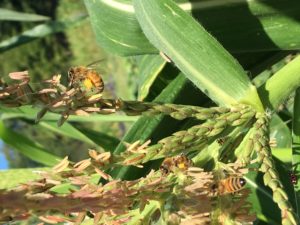 In between and in the midst of my farm workdays, trail meanderings, and recent bonfires beautiful threads of relationships have been cultivated. Through my role in the member bios project, I have gotten the privilege of interviewing several community members and gotten to know some of the stories and deeper layers of their lives. (If you haven’t already filled out the bio form, do so here!). Participating in community workdays, joining in on the “Bee Crew” through land stewardship circle, and teaching yoga classes at the Nest have also provided spaces to connect and weave my interests, curiosities, and passions into this community and to likewise receive the support, friendship, and guidance from others which has been invaluable in making this place feel like a home away from home.
 Integrating myself into an already established (yet forever evolving) community has brought with it ample opportunity for story sharing and importantly story listening. As the seasons begin to change and we are asked to create new rhythms I am encouraged to explore more deeply the history of this land, the stories she holds of this community and the ones before it. I am urged to continue to tend both to the human and more than human relationships that have blossomed here this summer and continue seeking ways of contributing myself to the soil of Common Ground.
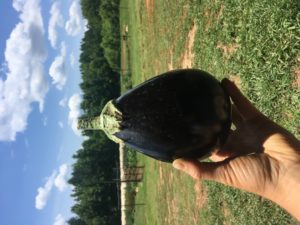 Doug Jones, a professional farmer here at CGEV, says that “collaborative farming is the farming of the future, a contrast to the small family farm that necessitates a large financial outlay. This is how farming has been practiced historically, as a tribe.” And this is how it is practiced at intentional agrarian communities. Doug, a resident in intentional communities for many decades, believes this way of life to be central to promoting collaborative farming.
 themselves.
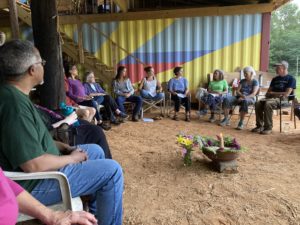 As many of you may know, last month Common Ground held its first racial reflection circle in order to both continue and start the conversation around race. Inspired by Juneteenth, we reflected on where the community is in terms of its racial awareness after a year of collective, national, and individual reckonings with the way race impacts our lives. The circle was facilitated by two newer members of the community- Jess Cudney and Lara Struckman as well as long time member Amy Halberstadt. We had a full circle of folks joining which demonstrated how needed and welcome this conversation was to the community.
 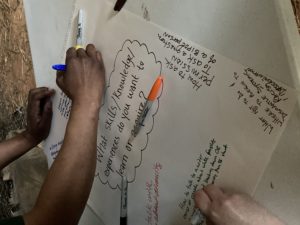 answer the following questions:
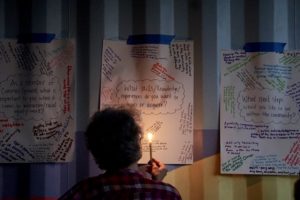 The event was warmly received and there was much rich dialogue during and following the event. Our hope is that this conversation continues both within Common Ground and in all of our lives as we embark maybe for the first or the hundredth time on our lifelong journey of anti-racism work and continually walk towards our mission of living in justice and harmony with each other and the land. If you have interest in helping facilitate more conversation, action, or celebration around racial equity and diversity feel free to reach out to Amy, Jess or Lara.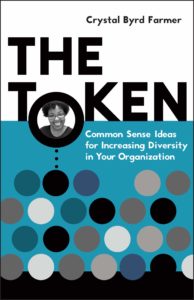
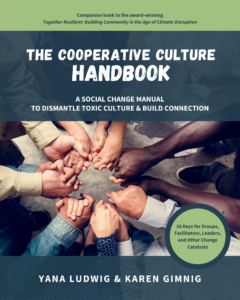 e reviewed Six Components of Conflict Resolution from the by Yana Ludwig and Karen Gimnig to help us to handle any disagreements or confusion. Crystal was patient and accepting while making sure we understood that unintentional harm still causes suffering. We were not patronized or coddled. We were informed that it is not fair to ask the person(s) harmed to reassure or comfort the person(s) causing harm. She defined microaggressions, cultural appropriation, subversive judgement of age, youth, disability, mental health, body size, skin color, cultural origins, sex & gender preferences, and I realized that these all exist in me.
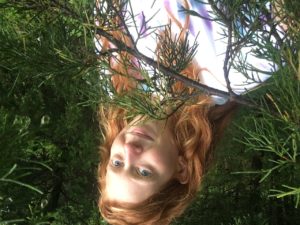 Being on this land for the past two weeks, I feel as though I have inhaled for the first time. “Ahh, this is what community is like,” my sweet breath says. These first few weeks of living and working as part of Common Ground Ecovillage have in many ways been a dream. I was met upon arrival with a warm and hearty welcome. Walking into the bustling barn that would become my new residence was intimidating at first but quickly became familiar and communal. Surrounded by a stunning array of green textures and hues, a guardian persimmon tree, and a sprightly pair of Carolina wren who visit me daily, beaks full, on my personal observation perch. I have been finding fulfillment both in simplicity and solitude as well as in the vibrant communal gatherings and passing conversations. I have been welcomed into the Nest for nourishing dinners and throughout the first week I was struck by the generosity of this community through the ways so many checked in on me, made sure I had what I needed, and were willing to chip in what they could to make here feel like home.
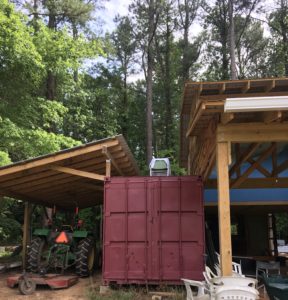 loved it. I relished in the way we kept time only by the amount of daylight left and not by watch or clock. I enjoyed using my body in service to that which is meaningful, getting to meet the crops and sing songs of praise and gratitude for their abundance and their thriving. On the more technical side of things, the first pages of my notebook are already filled with rememberings and teachings from Doug, Caleb, Margaret, and Jeffry. I am inspired by the way all of them work so diligently and calmly even amidst the trials and hinderences inherently present in this type of work.
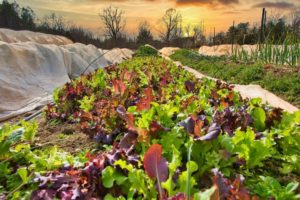 As I embark on the next 6 months here, it feels important to spend some time reflecting on why it is I am here and respond to what many have asked me so far which is what I hope to learn or receive from this experience. I said “yes” to this internship in part because I knew it would push me not only to grow both in my knowledge and experience of farming but also as a whole person. This intention has already been supported by the fact that in just 10 days I already feel in many ways changed. It is as if layers of noise are beginning to peel away to reveal an innate sense of belonging. Belonging to life, to myself, to others, and to land.
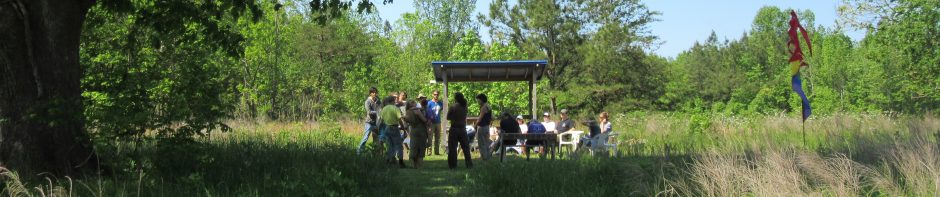
 It was a chilly, rainy Memorial Day weekend, but our spirits soared as we gathered to work on finishing our magnificent barn. Today’s main project was prepping and applying slip straw insulation to some remaining walls. Some, like Theresa, pitched in to the elbows and got busy. Others went to the far corners of the land to work on clearing some trails and forging others. Still others worked in the garden and helped prep farmer Doug’s weekly CSA. And it all came to a close with a fabulous potluck and a music jam at the fire drum circle…
 nd. Stepping from the lawn into the forest always takes my breath away, and I like to pause, consciously taking the first step, as if crossing a threshold into a magical place of wildness.
 After a few minutes Doug called to me and waved, so I made my way to the barn to see what I could help with. He pushed a garden cart and I followed with a wheelbarrow down to the rows that we would be harvesting. I was assigned the broccolini for starters. Doug found me a sharp blade and demonstrated how to select the tender shoots with miniature broccoli “heads” and how far to cut them down. It reminded me of pruning roses: make the cut just above the branch below that held the beginning of another tiny sprout. I had always assumed that “broccolini” was an early cutting of broccoli. What I learned was that regular broccoli sends out smaller side shoots after the main, larger head is cut. Broccolini, however, is a separate variety that only sends out the smaller “side shoots” with teeny broccoli “heads”. They’re lovely to munch on raw, and cut up for stir-frys or for steaming, only very light cooking is needed as they’re so tender. So I got to work. I had brought my trusty wooden stool in case I needed it, but held off as long as possible just because. I guess I wanted to wait and see how my back did. Well, about a quarter way down the row my lower back was starting to communicate with me rather vociferously, so I resigned myself to fetching the wooden stool. Ahh, much better! Doug and I chatted a bit, but it was clear that we were both working quickly in order to get in the harvest before he had to leave around 11:30 or so. There were two types of broccolini in the row, a green variety and a dark purple variety. I filled up the first 5 gallon bucket and about 1/3 of a second bucket, covering two sides of a single row.
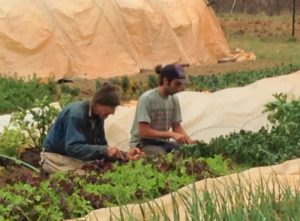 much away while picking, which I did of course. Picking them is done without a knife, just using the hands. Two hands actually, as you need to hold on to the plant while tugging just above the end of each pea. The tug is stronger than you would think, that’s why you need to hold down the plant to create some resistance, or you would pull the whole plant out. Doug showed me how the peas mature from the ground up, so the chubbiest peas, which are also the sweetest, are the ones near the bottom of the plant. It doesn’t really matter how long the pea is, but how chubby it is, and he showed me the minimum chubbieness to go for.
  I learned that the farm is prolifically producing, but unfortunately there are not enough CSA members to keep up with the abundance. So spread the word, and sign up yourselves! The produce is AMAZINGinly wonderful. I especially like that each week Doug sends you a list of what’s available, and you check off what you want and how many “units” of each. Then your order is available at a nearby pick-up spot.